Contents
There is a moment — 200 milliseconds after a user taps a button — where their brain decides whether the interface is alive or not.
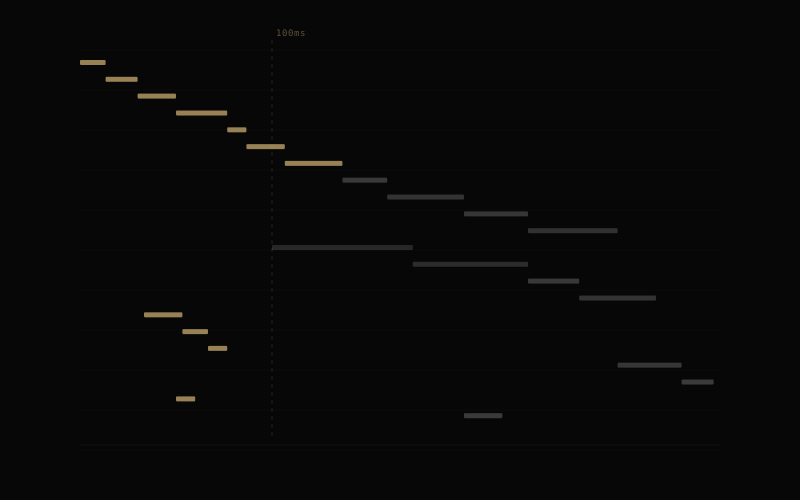
This is not metaphor. It is neuroscience. Interactions that respond within 100ms feel instantaneous. Between 100ms and 300ms, users perceive a delay but tolerate it. Beyond that, the spell breaks. The interface becomes a thing they are waiting on rather than a surface they are in conversation with.
#Speed as Respect
The fastest page I ever built had no analytics, no third-party fonts, no tag manager. Every removed kilobyte was a form of respect — for the user's time, their bandwidth, their device.
We talk about performance as if it is separate from design. An optimization pass you do afterward, a checklist you hand to your infrastructure team. But performance is the design. The first impression your interface makes is not visual — it is temporal.
#The Budget Mindset
Think in budgets. A mobile device on a mid-range connection has perhaps 100kb of JavaScript budget before interaction time exceeds 3 seconds. Every dependency you add is a withdrawal from that account.
This does not mean every project must be minimal. It means every project must be intentional. Adding three hundred kilobytes of animation library to make a button bounce is a choice with a cost. Make it consciously.
#What Good Looks Like
Good performance on the web in 2026 means:
- First Contentful Paint under 1.2 seconds on a 4G connection
- Interaction to Next Paint under 200ms for any user gesture
- Cumulative Layout Shift near zero — nothing should jump
These numbers are not arbitrary. They are the threshold where perception of quality changes.